Skip to content

Issue 95 |November/December 2025
PDF
Exhibit:
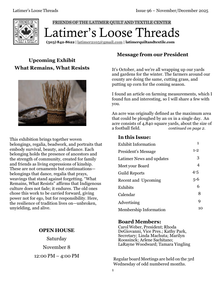
Stephanie Craig | "What Remains, What Resists"

This exhibition brings together woven belongings, regalia, beadwork, and portraits that embody survival, beauty, and defiance. Each belonging holds the presence of ancestors and the strength of community, created for family and friends as living expressions of kinship. These are not ornaments but continuations— belongings that dance, regalia that prays, weavings that stand against forgetting. “What Remains, What Resists” affirms that Indigenous culture does not fade; it endures. The old ones chose this work to be carried forward, giving power not for ego, but for responsibility. Here, the resilience of tradition lives on—unbroken, unyielding, and alive.
Download "LQTC - Newsletter - Issue 96 - NovDec 2025.pdf"

Issue 95 |September/October 2025

PDF
Exhibit:
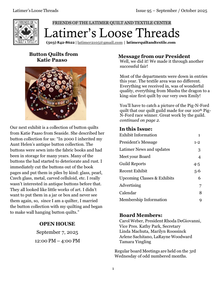
Katie Paaso | Button Quilts

Our next exhibit is a collection of button quilts from Katie Paaso from Seaside. She described her button collection for us: “In 2000 I inherited my Aunt Helen’s antique button collection. The buttons were sewn into the fabric books and had been in storage for many years. Many of the buttons the had started to deteriorate and rust. I immediately cut the buttons out of the book pages and put them in piles by kind: glass, pearl, Czech glass, metal, carved celluloid, etc. I really wasn’t interested in antique buttons before that. They all looked like little works of art. I didn’t want to put them in a jar or box and never see them again, so,  since I am a quilter, I married the button collection with my quilting and began to make wall hanging button quilts.” 

Download "LQTC_Newsletter_Issue_95_SeptOct_2025_Final_Digital_.pdf"

Issue 94 |July/August 2025

PDF
Exhibit:
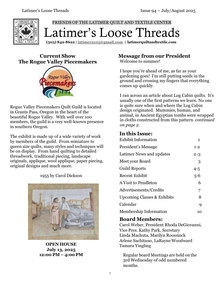
Rogue Valley Piecemakers

Rogue Valley Piecemakers Quilt Guild is located in Grants Pass, Oregon in the heart of the beautiful Rogue Valley. With well over 100 members, the guild is a very well-known presence in southern Oregon. The exhibit is made up of a wide variety of work by members of the guild. From miniature to queen size quilts, many styles and techniques will be on display. From hand quilting to detailed threadwork, traditional piecing, landscape originals, applique, wool applique, paper piecing, original designs and much more. 

Download "LQTC - Newsletter - Issue 94 - JulyAugust2025 (1).pdf"

Issue 93 |May/June 2025

PDF
Exhibit:
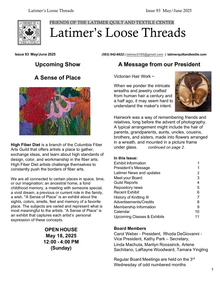
High Fiber Diet | "A Sense of Place"

High Fiber Diet is a branch of the Columbia Fiber Arts Guild that offers artists a place to gather, exchange ideas, and learn about high standards of design, color, and workmanship in the fiber arts. High Fiber Diet artists challenge themselves to constantly push the borders of fiber arts.

We are all connected to certain places in space, time, or our imagination; an ancestral home, a fond childhood memory, a meeting with someone special, a vivid dream, a previous or current role in the family, a wish. "A Sense of Place” is an exhibit about the sights, colors, smells, feel and memory of a favorite place. The subjects are varied and represent what is most meaningful to the artists. “A Sense of Place” is an exhibit that captures each artist’s personal expression of these concepts. 

Download "LQTC - Newsletter - Issue 93 - MayJune2025_FINAL.pdf"

Issue 92 |March/April 2025

PDF
Exhibit:
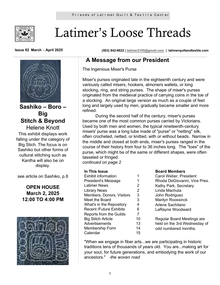
Helene Knott | Sashiko - Boro - Big Stitch & Beyond

This exhibit displays work falling under the category of Big Stich. The focus is on Sashiko but other forms of cultural stitching such as Kantha will also be on display.

The Art and Craft of Big Stitch - Helene Knott Sashiko, Boro, Kantha, and Kawandi… These all fall into the category of Big Stitch, also sometimes called Slow Stitch due to the relaxed, meditative pace. We live in an era of instant gratification, we want it fast, and we want it now. Much like the Arts & Crafts movement was a revolt to the Industrial Revolution, current interest in Slow Stitch arose to challenge the mechanization of machine stitching.

In hand quilting, the goal is to make stitches so small and close, they blend together to define a design line. With Big Stitch, defining a design line is still a goal but each stitch is also important. The stitches are larger and the thread thicker; the resulting work is more pleasingly rustic. Sashiko originated in Japan, probably around the 17th Century. As fabric is a fragile medium and the objects originally stitched with Sashiko utilitarian, only a few examples dating back more than 200 years exist. Sashiko was not practiced as a refined formal art to create objects of great beauty, it was rooted in practicality, it is only in recent times that Sashiko has evolved into a more decorative than functional craft. In past centuries, all fabric was made by hand, labor intensive to produce, and very precious. Sashiko was a way of strengthening and reinforcing cloth to make it wear better. Stitch a patch of fabric over a hole or thin spot on a garment, and it becomes Boro, or what in our current era is often called.

With limited resources, these patches rarely matched the cloth they were being used to repair, and this became a defining aspect of Boro, no attempt to hide the repairs were made and the rustic patches were considered beautiful in themselves. Other than the aim of using the stitches to attach a patch to another piece of fabric, a key difference between Boro and Sashiko lies in the design of the stitching. Sashiko consists of intricate patterns carefully stitched to preserve the design while the stitching that is used in Boro is more likely to be plain – a running stitch laid out in parallel rows or a grid pattern, Sometimes the linear stitching forms echoing shapes or spirals into the middle of the patch, and occasionally, the stitches might be a crude cross stitch. Sashiko has named patterns that are stylized representations of natural objects – waves, flowers, tree bark… Boro stitching makes no attempt to mimic a natural design, it is purely functional. As a comparison, think of a quilt made of 4-patch blocks compared to a pattern such as a Feathered Star. 

Download "LQTC - Newsletter - Issue 92 - MarApr2025.pdf"

Issue 91 | January/February 2025

PDF
Exhibit:
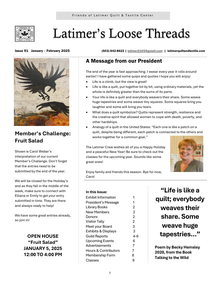
Latimer Member Challenge | "Fruit Salad"
 

Download "LQTC - Newsletter - Issue 91 - JanFeb2025.pdf"